
Descending order
The order of the list indicates proportion. The quantity of ingredients alone does not determine the quality of the product. Compare the composition, the function of the ingredients, and the suitability for the intended use.
Ingredients, origin, and indications — read critically without interpreting seals as absolute certification.
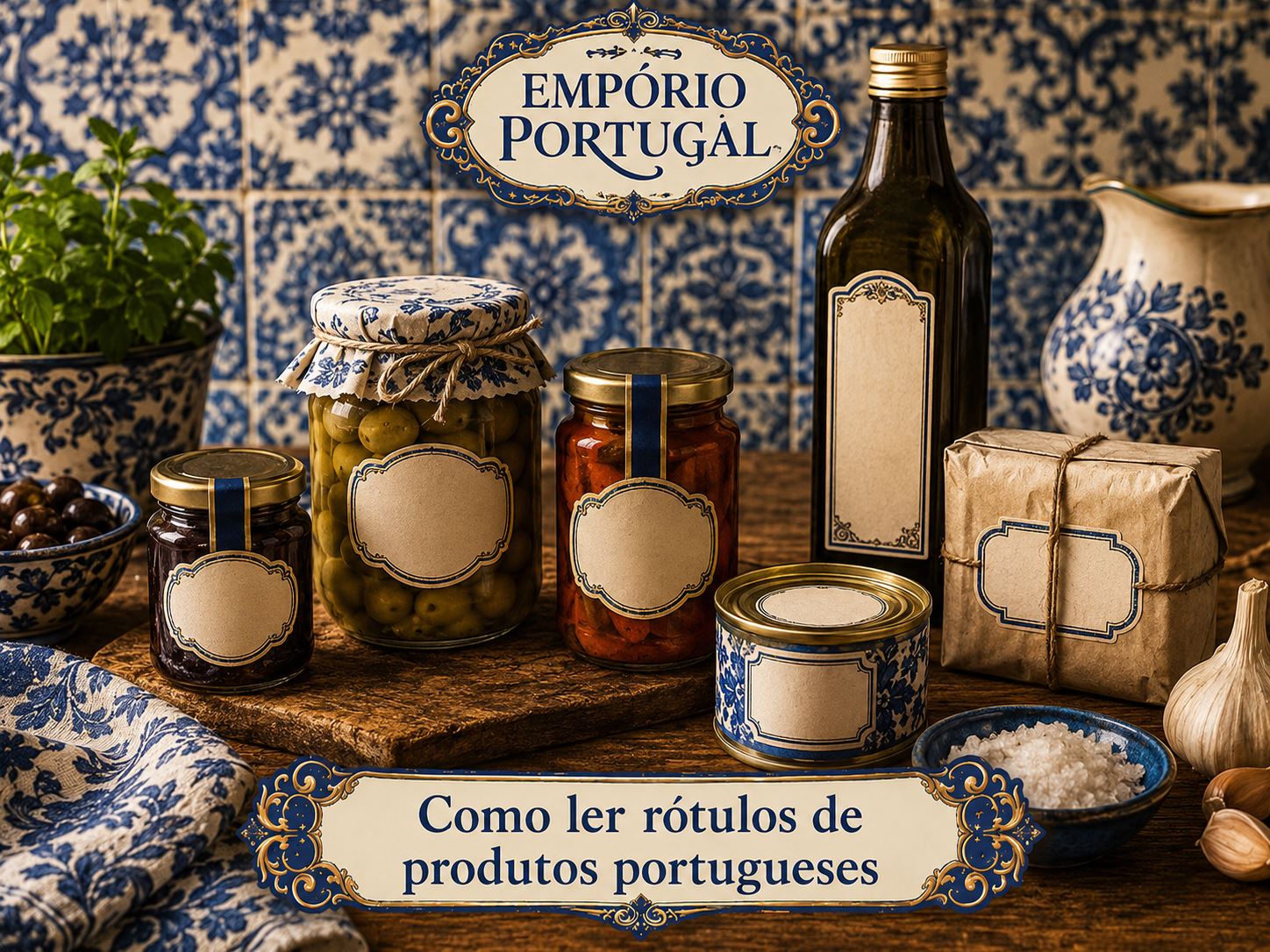
Olive oil, canned goods, sausages, and Portuguese cheeses provide regulated information — origin, ingredients, allergens, and deadlines — but visual seals do not always mean official certification.
An informed consumer compares the ingredient list, country of origin, and storage conditions. This guide is editorial: it guides reading critically and does not replace the official information on the label or the rules applicable to the market where the product is sold.
Points mentioned in this guide — without inventing mandatory fields beyond the editorial content.
Locate the list — the order indicates proportion (reading in descending order).
Identify highlighted allergens — in this guide: gluten, milk, nuts.
Check the country of origin and packer. Compare with the objective information on the label.
Compare official DOP/IGP seals with decorative symbols. Not every visual seal is certification.
Observe the expiration date and preservation conditions indicated on the label.
Keep the label if there is any doubt about the batch. Batch and validity matter in imported products.
For olive oil, look for variety, acidity, and extra virgin when applicable.
For canned goods, note drained weight versus liquid.
Read ingredients in descending order and compare what is written — not what the packaging visually suggests.
The order of the list indicates proportion. The quantity of ingredients alone does not determine the quality of the product. Compare the composition, the function of the ingredients, and the suitability for the intended use.
Do not ignore hidden sugar or salt in the middle of the list.
Translation in Brazil may use different names — compare the base ingredient.
Be wary of vague terms like “artisanal” without context. Do not assume homemade artisanal in an industrial product.
Check highlighted allergens on the official label. This guide does not invent complete legal lists.
Identify highlighted allergens. Examples mentioned in this guide: gluten, milk, nuts.
To check if a canned good is suitable for those avoiding gluten, do not conclude solely based on the expression “modified starch.” Check the origin of the ingredient, the allergen declaration, and the indication about gluten present on the label applicable to the market.
In case of dietary restrictions, consult the official label of the product and, when necessary, seek professional guidance. Highlighting rules may vary according to the market.
Confirm origin in the text of the label — not just in the image of the packaging.
Check the country of origin and packer. The location of the company on the packaging should not be interpreted alone as a guarantee of origin.
Common mistake: confusing the image of a flag with guaranteed origin. The objective information is in the text of the label.
Differentiate marketing from official DOP/IGP. Visual seals do not always mean official certification.
Compare official DOP/IGP seals with decorative symbols. Coats of arms, medals, flags, or landscapes do not alone prove protected origin.
DOP and IGP are distinct regimes. In DOP, the raw materials and all stages of production are linked to the defined geographical area. In IGP, at least one stage of production, transformation, or preparation occurs in the region. Not every Portuguese product has these indications.
The label provides objective data; interpretation should consider the type of product and the market. Advertising text does not replace the essential information on the label.
Read with criteria: do not interpret any visual seal as absolute certification. When in doubt, keep the label and check the full name of the indication.
Follow the conditions indicated on the manufacturer's label — this guide does not replace them.
Observe the indicated expiration date.
Observe the preservation conditions on the label.
Keep the label if there is any doubt about the batch.
Batch and validity matter in imported products. Translation in Brazil may use different names — compare the base ingredient.
For olive oil, check the declared category, origin, validity, and preservation conditions. Acidity and harvest year should be considered when stated on the label. In virgin and extra virgin olive oils, the harvest year is an optional indication and can only be presented when 100% of the content of the package comes from a single harvest year.
Note drained weight versus liquid.
Editorial checklist based on this guide.
No. DOP and IGP are distinct regimes. In DOP, the raw materials and all stages of production are linked to the defined geographical area. In IGP, at least one stage of production, transformation, or preparation occurs in the region. Not every Portuguese product has these indications.
For olive oil, check the declared category, origin, validity, and preservation conditions. Acidity and harvest year should be considered when stated on the label. In virgin and extra virgin olive oils, the harvest year is an optional indication and can only be presented when 100% of the content of the package comes from a single harvest year.
Check the allergen declaration and the indication about gluten on the label. The expression “modified starch,” alone, does not allow concluding whether the product contains gluten or not.
Adjust ingredients and techniques according to dietary restrictions, allergies, proper preservation, and professional guidance when necessary.
This guide is part of the editorial curation of Empório Portugal. Culinary and purchasing practices may vary by region, family, and cook. It does not invent legal rules: read the official label of the product and the rules of the market where it is sold.
Send it to the Empório Portugal community. All content received goes through analysis before any publication.
Share Empório Portugal with someone who enjoys Portuguese gastronomy and culture.